



Heat Pumps vs Traditional Boilers: What's Best for Your Home?
It’s the big heating debate of the decade. Your current boiler is making noises that belong in a haunted house, your energy bills are creeping up, and you’re faced with a choice: do you stick with what you know, or is it time to look at renewables?
We get it. Choosing a new heating system feels like a massive commitment. You’re weighing up upfront costs, worrying about the disruption of lifting floorboards, and ultimately just wanting to know if a new system will actually keep your house warm when the UK winter bites.
As a family-run plumbing and heating business based right here in Sutton, we spend our days (and often our nights) working on heating systems across South London and Surrey. We’ve seen the good, the bad, and the freezing cold. This guide is designed to cut through the jargon and help you compare a heat pump vs boiler, so you can make the right decision for your property.
Quick answer (if you’re in a hurry)
If you just want the bottom line on the heat pump vs boiler debate, here’s a quick summary:
Choose a modern gas boiler if:
You want the lowest upfront installation cost.
You have limited outdoor or indoor space.
Your home relies on high-temperature radiators.
You want the job done with minimal disruption.
Choose an air source heat pump if:
Your home is well insulated (or you’re willing to upgrade it).
You’re planning to stay in the property long-term.
You’re open to upgrading your radiators or installing underfloor heating.
You want to lower your carbon footprint and access government grants.
Ultimately, the best option depends entirely on your home’s fabric and emitters. What works for a modern new build might not work for a draughty 1930s semi without some serious upgrades first.
How each system works (without the engineering lecture)
Before you can decide which is best, it helps to know how they actually heat your home. We promise to keep the technical speak to a minimum.
Traditional gas boiler basics
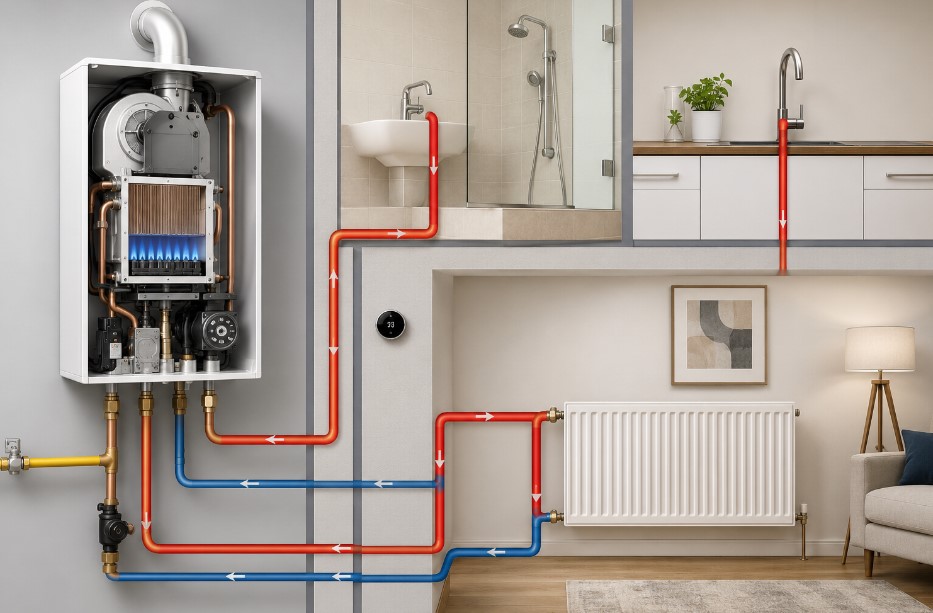
A gas boiler is straightforward: it burns gas to heat water, which is then pumped around your radiators and out of your taps. They are fantastic at producing high flow temperatures quickly. If you want your house to go from freezing to toastie in 30 minutes, a gas boiler is your friend. They are familiar, compact, and quick to install.
Air source heat pump basics
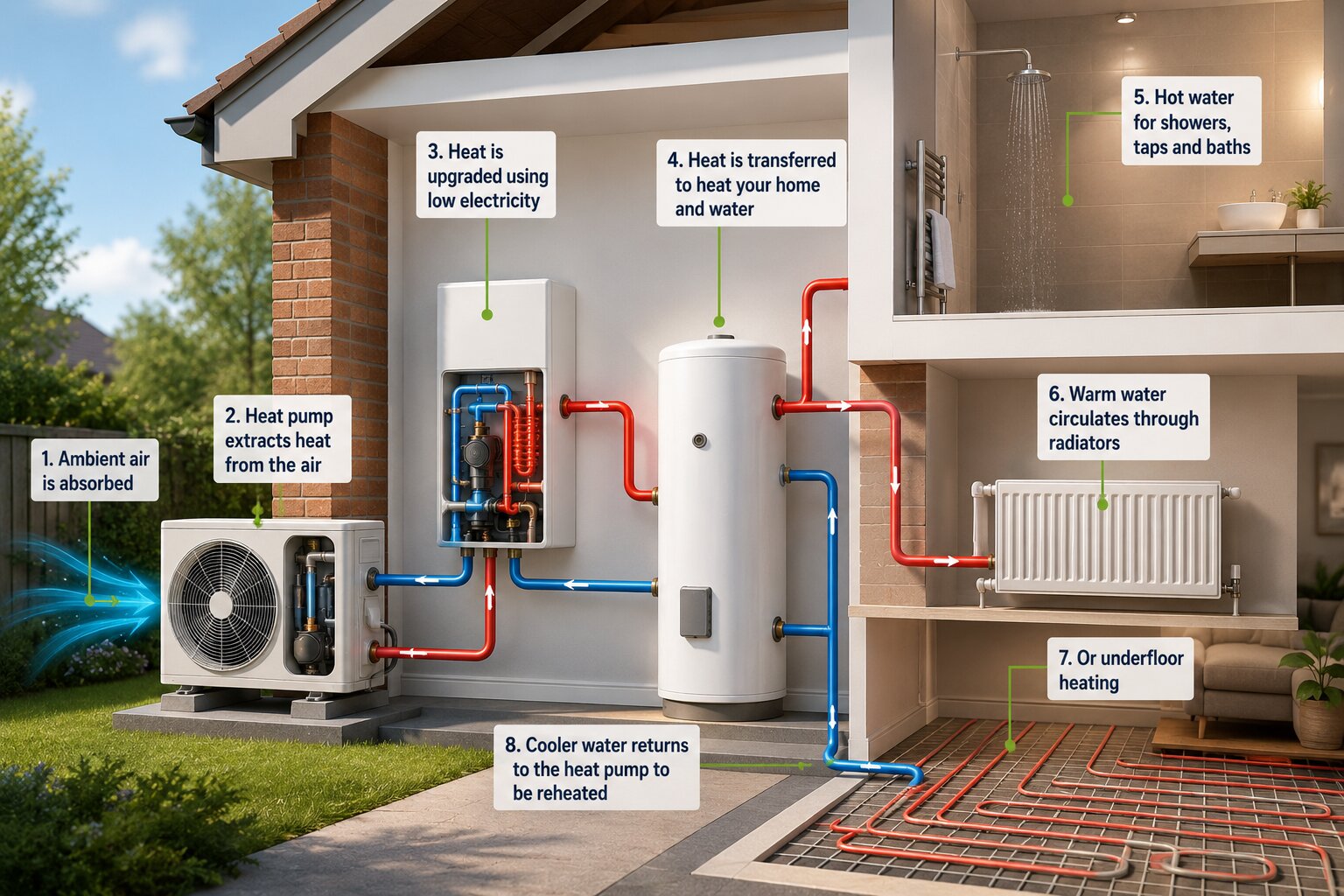
Think of a heat pump like a fridge working in reverse. Heat pumps work by extracting ambient heat from the outside air, compressing it to increase the temperature, and then transferring that heat into your home.
Because they extract heat rather than generating it from scratch, they are incredibly efficient—often producing three or four units of heat for every unit of electricity used. However, they work best at lower flow temperatures over much longer periods. They provide a steady, constant warmth rather than quick blasts of heat. You’ll also typically need a hot water cylinder to store your domestic hot water.
Heat pump vs gas boiler: key differences that actually matter
Let’s look at how a heat pump vs gas boiler stacks up in the real world.
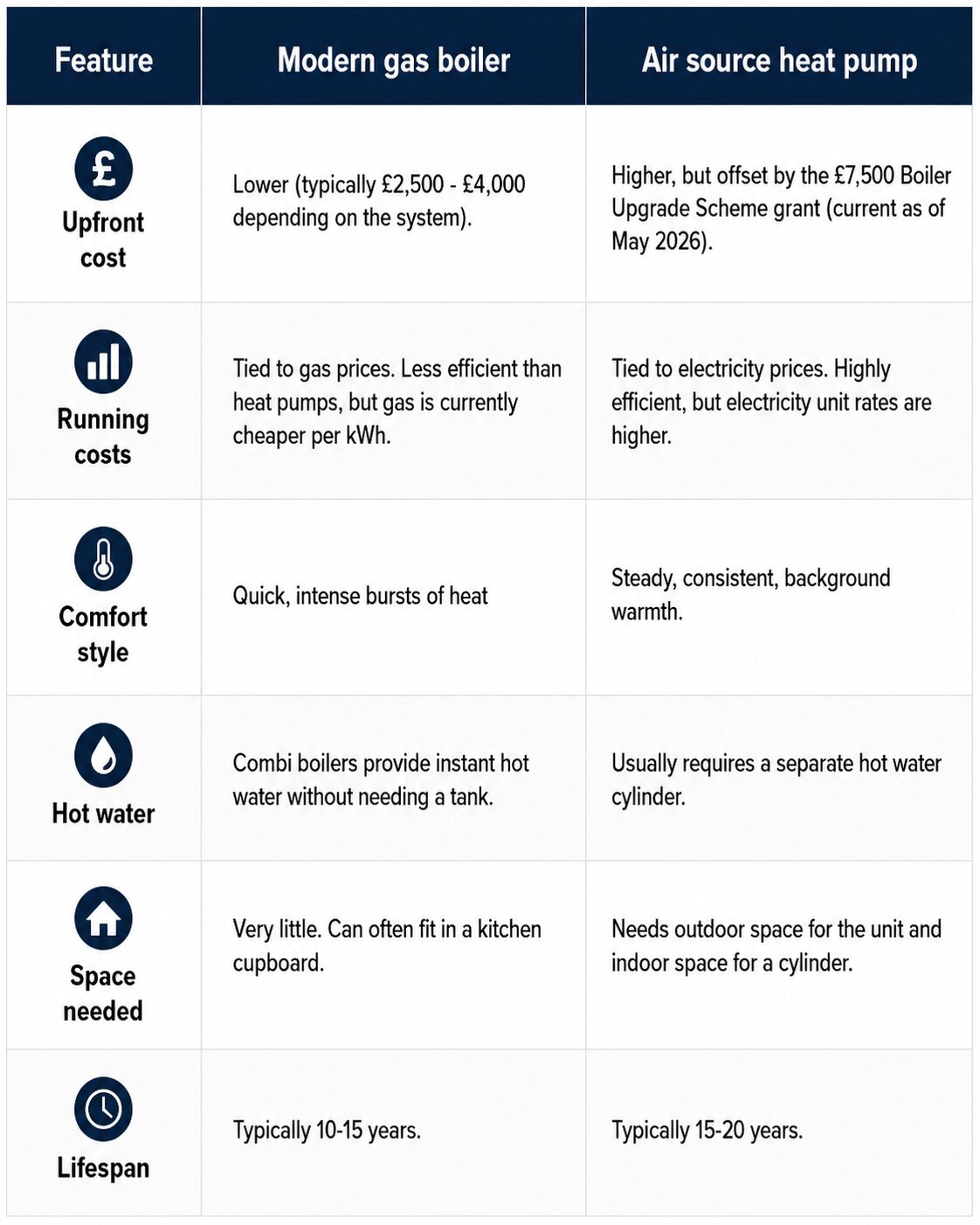
Is a heat pump better than a boiler for Surrey homes?
So, is a heat pump better than a boiler? The honest answer is: it depends entirely on your property.
Here in Surrey, we have a massive mix of housing stock. If you live in a modern, well-insulated home, a heat pump system is often a brilliant choice. The low flow temperatures work perfectly with good insulation and underfloor heating.
However, if you live in a classic 1930s semi or a Victorian terrace in Epsom or Carshalton, things get trickier. These older properties leak heat. If you install a heat pump without upgrading your insulation or fitting larger radiators, the system will struggle to keep the house warm and your electricity bills will skyrocket.
For flats, the issue is usually space and planning permission. Finding a suitable spot for the outdoor unit that meets noise regulations can be a headache.
Running costs: is a heat pump more energy efficient than a gas boiler?
This is the question we get asked most often: does a heat pump cost less to run than a gas boiler?
Currently, electricity is significantly more expensive per unit (kWh) than gas in the UK. However, because heat pumps are so much more efficient—producing roughly 300-400% energy efficiency compared to a gas boiler’s 90-95%—the running costs often balance out.
If your heat pump is designed and installed correctly, and your home is well insulated, it can be cheaper to run. But if your home loses heat rapidly, the heat pump will have to work overtime, and those expensive electricity units will quickly add up.
If you want a realistic idea of running costs, we can help assess your current gas usage and heat loss to give you a clearer picture.
Installation and disruption: what to expect either way
Nobody likes having their house turned upside down. Here is what you need to prepare for.
Boiler replacement
Swapping an old boiler for a new one is usually a straightforward job. A like-for-like swap can often be completed in a single day. If we need to upgrade your flue, alter pipework, or fit smart heating controls, it might take a little longer, but the disruption is generally minimal.
Boiler to heat pump upgrade
A boiler to heat pump replace project is a much bigger task. We need to find a suitable location for the outdoor unit, run new pipework, and likely find space for an unvented hot water cylinder.
Crucially, we almost always need to check and potentially upgrade your radiators to ensure they are large enough to work with the lower flow temperatures. The whole process takes several days and involves a fair bit of upheaval.
Is it worth upgrading to a heat pump?
If you are weighing up whether is it worth upgrading to a heat pump, use this simple framework:
It is likely worth it if:
You plan to stay in the property for many years to see a return on investment.
Your home is already well insulated (or you are happy to upgrade it).
You have the space for the equipment.
Reducing your carbon footprint is a priority.
It might not be worth it right now if:
You have no space for an outdoor unit or hot water cylinder.
Your home is poorly insulated and you can’t afford to improve it.
You need high temperatures constantly.
You want the cheapest possible upfront fix.
If a heat pump isn’t right for you yet, a highly efficient new boiler installation is still a massive step up from a failing, decades-old system.
Our practical checklist (before you choose anything)
Before you make any decisions, run through this quick checklist:
How old is your boiler? If it’s breaking down constantly, doing nothing is no longer an option.
How good is your insulation? Check your loft, walls, and draught proofing.
Are your radiators getting cold spots? It might be time for a powerflush or an upgrade.
How much hot water do you use? Think about morning shower rushes and large baths.
Do you have the space? Measure up for potential cylinders and outdoor units.
What are your controls like? Upgrading to smart controls can save money on any system.
FAQ
What’s the main difference between a heat pump and a boiler?
A boiler burns fuel (gas or oil) to generate heat quickly at high temperatures. A heat pump uses electricity to extract ambient heat from the outside air, warming your home slowly and steadily at lower temperatures.
Are heat pumps just as effective in the winter?
Yes, absolutely. Modern heat pumps are designed to extract heat from the air even when temperatures drop to -20°C. The key is ensuring your home is insulated enough to hold that heat in.
Do I need to replace my radiators for a heat pump?
Often, yes. Because heat pumps use lower flow temperatures, they usually require larger radiators (or underfloor heating) to emit enough warmth into the room.
Is a heat pump cheaper to run than a gas boiler?
It can be, but it depends on the efficiency of the installation and your home’s heat loss. Because electricity unit rates are higher than gas, the system must run efficiently to generate savings.
What’s the difference between air source and ground source heat pumps?
Air source heat pumps extract heat from the outside air, even at low temperatures, and transfer it to your home for heating and hot water. They are generally easier and cheaper to install compared to ground source heat pumps, but they may be slightly less efficient in very cold conditions. Ground source heat pumps, on the other hand, use heat from the ground through a closed loop of pipes buried underground. These systems are highly efficient as ground temperatures remain consistent throughout the year, but they require more space and a higher upfront cost due to excavation work.
Can I get a grant from the UK Government to help towards a heat pump?
Yes, the UK Government currently offers the Boiler Upgrade Scheme, which provides grants to help with the cost of installing low-carbon heating systems such as heat pumps. Eligible homeowners in England and Wales can receive £5,000 for an air source heat pump or £6,000 for a ground source heat pump. To qualify, you will need to meet the scheme’s criteria, and an accredited installer must carry out the installation. This initiative is part of the government’s effort to reduce carbon emissions and promote sustainable heating solutions.
How long does installation take for a boiler vs heat pump?
A straight boiler swap takes 1-2 days. A full heat pump installation, including new cylinders and radiator upgrades, typically takes 3-5 days or more.
Do heat pumps need servicing?
Yes, just like boilers, heat pumps require annual servicing to maintain their efficiency and protect their warranties. We offer comprehensive heat pump care plans to keep everything running smoothly.
What’s best for hot water: combi boiler or heat pump cylinder?
A combi boiler is best if you want instant hot water and lack storage space. A heat pump and cylinder setup is great if you have multiple bathrooms and high simultaneous hot water demand.
Do you cover my area?
We serve homes across Sutton, South London, and Surrey, including Epsom, Carshalton, and the surrounding areas.
Wrapping up
There is no one-size-fits-all answer to the heating debate. The "best" system is the one that aligns with your property, your budget, and how you actually live in your home. Whether that means embracing renewable tech or sticking with a reliable, modern gas boiler, the priority should always be safe, efficient, and consistent warmth.
Let’s get your heating sorted
Still unsure what the best move is for your property? That’s exactly what we are here for. We don’t believe in pushy sales tactics or cutting corners. We provide honest, on-the-tools advice tailored to your specific home.
Whether you need a boiler replacement, want to explore heat pump services, or just need a reliable engineer for boiler servicing, get in touch. We offer same-day appointments, clear upfront pricing, and a fast response across Sutton and Surrey.
Give us a call ,drop us an email, or visit our contact page to request a callback today.


