



Signs You Need to Replace Your Boiler Before Winter
If your boiler is over 10-15 years old, breaks down repeatedly, loses pressure often, makes strange noises, or burns with a yellow flame instead of blue, it's time to consider a replacement. Acting before winter means you get to choose a new boiler on your own schedule, rather than during an emergency call-out when temperatures drop.
There's nothing quite like a lukewarm shower on a frosty morning to remind you that your boiler isn't getting any younger. If yours has been grumbling, losing pressure, or just generally acting up, you're probably wondering whether it's worth another repair or if it's time to let it retire gracefully.
At RCB Plumbing, we've spent over 24 years helping homeowners across Sutton, Surrey, and South London keep their heating systems running smoothly, especially when the cold weather hits hardest. We've seen pretty much every boiler fault going, and we know the difference between a quick fix and a sign that something bigger is brewing.
In this guide, we'll walk you through the clearest signs you need to replace your boiler, how to tell a repair from a replacement situation, and what to do next if you suspect yours is on its way out.
Why boiler problems always seem to happen when it's freezing
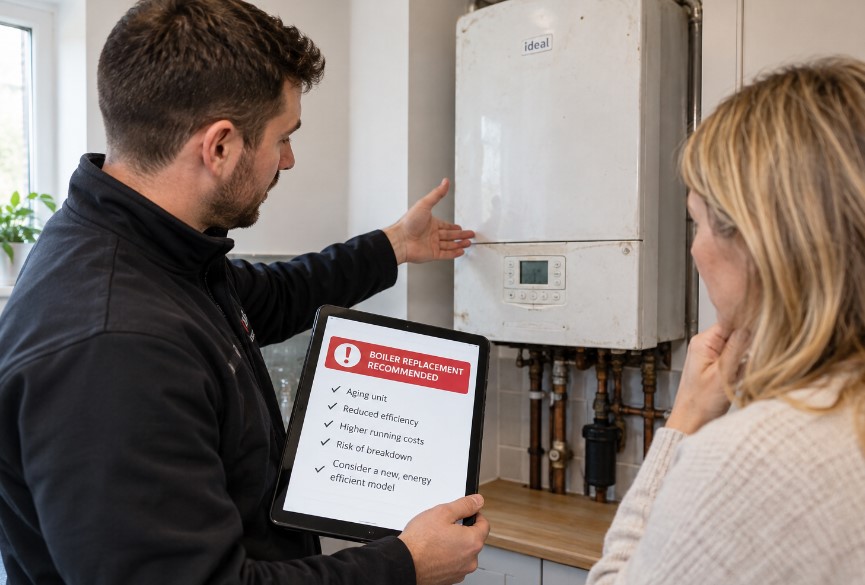
There's a reason boilers tend to fail in winter rather than, say, a sunny Tuesday in June. Cold weather means your boiler is working far harder and far longer than it does the rest of the year. Return water temperatures drop, components are under more strain, and any underlying weaknesses get pushed to breaking point. Check boiler care plans.
This is exactly why a pre-winter check makes so much sense. Catching a fault in October beats discovering it in the middle of a December cold snap, when engineers are busier and your patience for cold radiators is considerably thinner.
Repair or replace? Here's how to decide
Not every boiler fault spells the end. Sometimes a faulty part or a quick service sorts things out completely. But a few factors tend to tip the scales towards replacement:
Age: Most boilers last 10 to 15 years with good maintenance. Beyond that, parts become harder to source and efficiency drops off.
Frequency of breakdowns: One fault is an inconvenience. Three in a year is a pattern.
Cost of repairs: If you're spending hundreds on repairs annually, that money's often better put towards a new, more reliable system.
Efficiency: Boilers made before 2010 can run as low as 65% efficient, compared to over 90% for a modern condensing boiler.
Safety: Some issues, like a yellow flame, aren't up for debate. They need addressing immediately.
If you're not sure which camp your boiler falls into, we're always happy to take a look and give you straightforward, honest advice. No pressure, no upselling, just a clear picture of your options.
12 signs you need to replace your boiler before winter hits

Here are the warning signs worth taking seriously:
1. Your boiler is 10 to 15 years old (or older). Even if it's still limping along, an older boiler is statistically more likely to let you down when you need it most.
2. It breaks down more than once a year. If calling an engineer has become something of a seasonal tradition, that's a strong hint.
3. Repair bills keep adding up. Once you've spent a sizeable chunk of a new boiler's cost on patch-up jobs, it's worth doing the maths properly.
4. Your energy bills have crept up. A struggling boiler has to work harder to produce the same heat, and that shows up on your bill.
5. Some radiators run hot, others stay stubbornly cold. This can point to a tired boiler, a sizing issue, or a system that needs flushing.
6. Your hot water temperature swings about. Hot one minute, lukewarm the next. Scaled components or failing sensors are often to blame.
7. It's making odd noises. Banging, whistling, or gurgling (often called "kettling") usually means limescale or sludge build-up, air in the system, or low pressure.
8. It keeps losing pressure. The occasional top-up is normal. Doing it weekly is not.
9. The flame has turned yellow or orange instead of blue. This is a genuine safety concern, as it can indicate incomplete combustion and potential carbon monoxide risk. Get it checked straight away.
10. You've spotted leaks or corrosion. A bit of condensation is normal; rust spots and persistent drips are not.
11. Parts are becoming difficult to find. Older or discontinued models can mean longer waits and higher costs for repairs.
12. Your household has outgrown it. New bathroom, more occupants, bigger hot water demand? Your old boiler might simply not be built for it anymore.
If several of these sound familiar, that's usually the clearest sign you need to replace your boiler rather than keep nursing it along.
Common winter boiler failures (and why replacing early helps)
A few faults crop up again and again once the temperature drops:
Frozen condensate pipes, which can shut the whole system down
Ignition and fan problems, often from components working overtime
Pressure issues, exacerbated by the system running almost constantly
Replacing a boiler on your own terms, before any of this happens, means you get to choose the right model, compare your options properly, and budget sensibly. An emergency replacement in January tends to be rushed, stressful, and more expensive.
What a new boiler actually improves
A boiler replacement isn't just about avoiding breakdowns. Modern systems genuinely perform better:
More consistent heating and hot water, without the temperature lottery
Higher efficiency, often above 90%, which helps keep bills in check
Smart thermostat compatibility, so you can fine-tune your heating from your phone
Quieter operation, with none of the kettling or banging
Fewer breakdowns, simply because newer parts haven't had years to wear down
If you're weighing up boiler replacement in Surrey or South London, we cover both areas regularly and can talk you through which models suit your home. Check new boiler checklist.
Getting ready for a boiler replacement
A little preparation makes the whole process smoother:
Note your current boiler's make, model, and fault history
Think about your household's hot water demand (showers, baths, number of people)
Consider whether you'd like smart heating controls added
Clear the area around your boiler for easy access
Book your assessment early, ideally before winter diaries get busy
Why homeowners across Surrey and South London choose us
We've been fixing, servicing, and replacing boilers for over 24 years, so we've learned a thing or two about doing the job properly. Here's what you can expect from us:
Clear, upfront pricing with no surprise add-ons
Same-day appointments where available
Careful, tidy workmanship from start to finish
Honest advice, even if that means recommending a repair over a replacement
Frequently asked questions
How long does a boiler typically last?
Most boilers last between 10 and 15 years, depending on the model, usage, and how well it's been maintained.
Is it worth replacing a boiler before it breaks completely?
Often, yes. Replacing on your own schedule means you can compare options and budget properly, rather than scrambling for an emergency fix mid-winter.
What time of year is best to replace a boiler?
Autumn is ideal. You'll beat the winter rush and have your new system ready before the cold weather sets in properly.
How do I know if I need a bigger boiler?
If your household has grown, or you've added a bathroom, your current boiler may struggle to keep up. We can assess your hot water demand and recommend the right size.
Will a new boiler lower my energy bills?
In most cases, yes. Modern condensing boilers run considerably more efficiently than older models, which often translates into lower running costs.
How often should a boiler be serviced?
An annual service is recommended to catch small issues early and keep your warranty valid.
Can you replace boilers in older or period homes?
Yes. We regularly work on Victorian and older properties across Sutton and the surrounding areas, and can advise on the best setup for your home's layout.
Do you cover Sutton, Surrey, and South London?
We do. It's our local patch, and we know the area well.
Don't let your boiler make the decision for you
A boiler that's on its last legs has an unhelpful habit of giving up at the worst possible moment. If you've spotted any of the signs above, get in touch with us before winter takes hold. We'll give you honest advice, a clear quote, and a boiler replacement that actually gets you through the cold months without drama.
Call us or email us and we’ll be happy to chat through your options, no obligation or pressure.


